


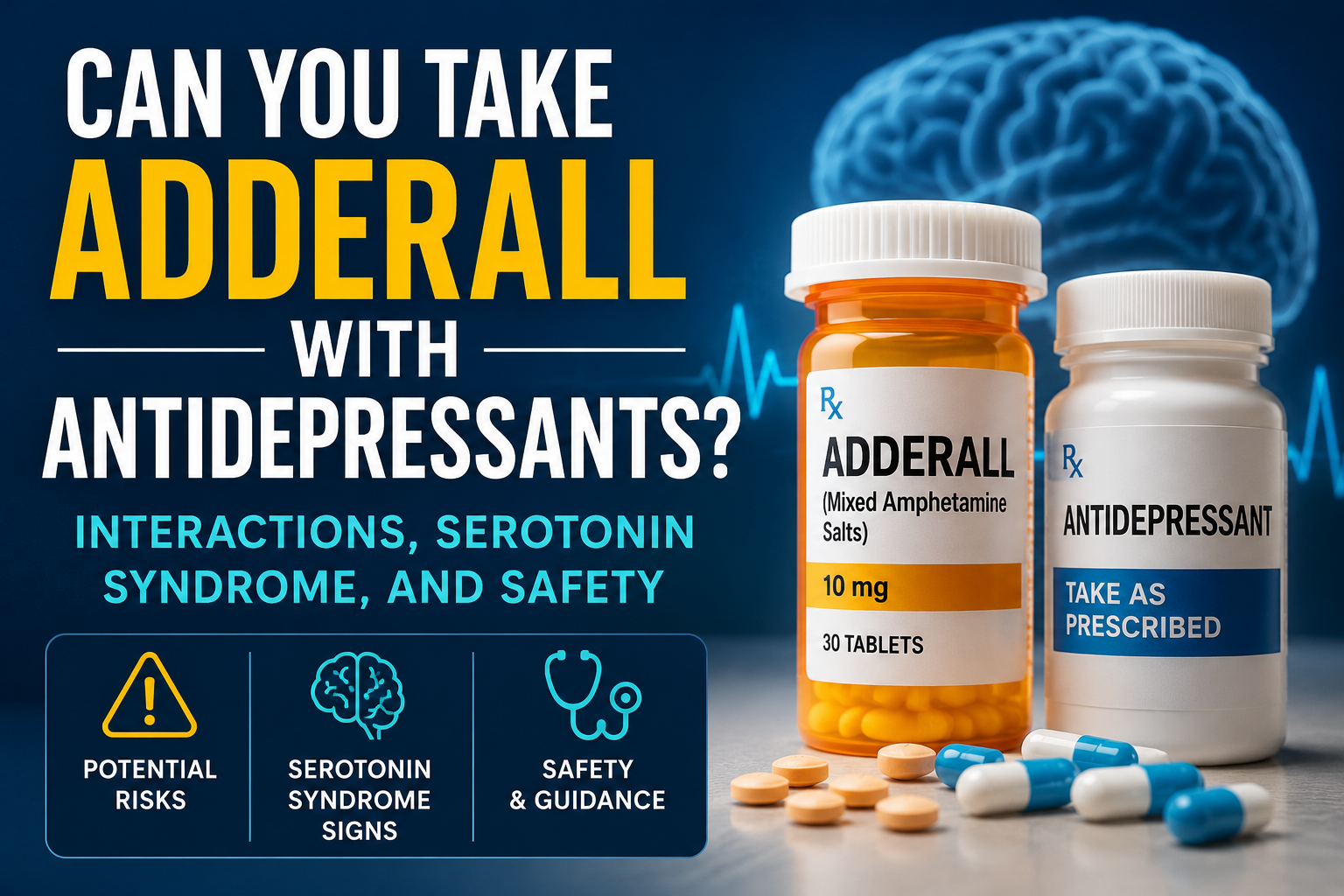
Quick answer: Yes — Adderall and many antidepressants are commonly prescribed together under medical supervision, because ADHD and depression or anxiety frequently occur side by side. But the combination is not automatically safe: MAOI antidepressants are strictly contraindicated with Adderall, some SSRIs raise amphetamine levels in the blood, and any serotonergic antidepressant adds a small but real risk of serotonin syndrome. The difference between a safe combination and a dangerous one is whether a prescriber who knows about both medications is managing them.
If you or someone you love is experiencing severe agitation, high fever, racing heart, muscle rigidity, or confusion after combining stimulants with other medications, call 911. For confidential help with prescription stimulant misuse, Every1 Center’s helpline is available 24/7 at (518) 714-0355.
Key Takeaways
- ADHD and depression are frequently co-occurring, and Adderall is often safely co-prescribed with SSRIs such as sertraline or escitalopram under medical supervision.
- MAOIs (phenelzine, tranylcypromine, selegiline) must never be combined with Adderall — the interaction can cause hypertensive crisis and dangerous serotonin elevation. A 14-day washout is required between them.
- Fluoxetine (Prozac) and paroxetine (Paxil) inhibit the CYP2D6 enzyme that helps clear amphetamine, which can raise Adderall levels and intensify side effects at the same prescribed dose.
- Serotonin syndrome — agitation, tremor, sweating, fever, racing heart, muscle twitching — is uncommon with prescribed combinations but a medical emergency when it occurs.
- Risk rises sharply when Adderall is taken above the prescribed dose, without a prescription, or alongside other substances — the people most likely to be harmed by this interaction are not the ones taking both as directed.
- Never stop or adjust either medication on your own; abrupt changes to antidepressants or stimulants each carry their own withdrawal effects.
Why Adderall and Antidepressants Are Prescribed Together
Adults with ADHD have substantially higher rates of depression and anxiety than the general population, and treating one condition while ignoring the other usually fails both. That’s why a prescriber may deliberately combine a stimulant like Adderall (mixed amphetamine salts) with an antidepressant — most often an SSRI. Managed together, with one prescriber aware of both medications, the combination is routine psychiatric practice.
The problems arise in three situations: when the antidepressant is the wrong class to combine with a stimulant, when one prescriber doesn’t know what the other prescribed, or when the Adderall isn’t being taken as prescribed at all.
Adderall Interactions by Antidepressant Type
| Antidepressant class | Examples | Interaction with Adderall | Bottom line |
|---|---|---|---|
| MAOIs | phenelzine (Nardil), tranylcypromine (Parnate), selegiline (Emsam) | Blocks breakdown of amphetamine and norepinephrine; can trigger hypertensive crisis and severe serotonin elevation | Never combine. 14-day washout required between an MAOI and Adderall |
| SSRIs | sertraline (Zoloft), escitalopram (Lexapro), fluoxetine (Prozac), paroxetine (Paxil) | Additive serotonergic activity; fluoxetine and paroxetine also inhibit CYP2D6, raising amphetamine blood levels | Commonly co-prescribed with monitoring; report new agitation, tremor, or sweating promptly |
| SNRIs | venlafaxine (Effexor), duloxetine (Cymbalta) | Additive serotonergic and noradrenergic effects; can compound elevated heart rate and blood pressure | Used together with caution; blood pressure and pulse worth monitoring |
| Bupropion | Wellbutrin | Both are stimulating; additive effects on heart rate, blood pressure, insomnia, and (at high doses) seizure threshold | Sometimes combined deliberately for ADHD + depression; dose and history matter — prescriber’s call |
| Tricyclics | amitriptyline, nortriptyline | Amphetamine can potentiate cardiovascular effects of TCAs | Less common today; requires cardiac awareness and supervision |
This table summarizes general interaction patterns; it is not a substitute for a prescriber’s judgment about your specific medications, doses, and health history.
Serotonin Syndrome: The Warning Signs That Matter
Amphetamines increase serotonin activity, and so do most antidepressants. When total serotonergic load climbs too high, the result is serotonin syndrome — uncommon with supervised prescribing, but a genuine emergency when it happens. It typically develops within hours of a dose increase or a new combination, not gradually over weeks.
Early signs include restlessness or agitation, tremor, heavy sweating, racing heart, and dilated pupils. Severe cases progress to high fever, muscle rigidity or rhythmic twitching (especially in the legs), confusion, and loss of coordination. Severe symptoms are a 911 situation, not a wait-and-see situation.
Clinical note: The highest-risk window is not long-term stable use — it’s the first days after something changes: a new antidepressant added to existing Adderall, a dose increase on either side, or an extra “as-needed” stimulant dose a patient didn’t mention. When symptoms appear, the question to ask first is what changed this week?
Why Prozac and Paxil Raise Adderall Levels
Amphetamine is partly cleared by the liver enzyme CYP2D6. Fluoxetine and paroxetine are strong inhibitors of that enzyme — so adding either one can slow the breakdown of Adderall, effectively raising its blood level without any change in the prescribed dose. Patients sometimes experience this as the Adderall suddenly feeling “stronger”: more jitteriness, higher heart rate, worse insomnia, more appetite suppression.
This is manageable when the prescriber knows both medications are on board — doses can be adjusted. It becomes a problem when the two prescriptions come from different providers who never compare notes, which is one more reason every prescriber should have the complete medication list.
When the Combination Turns Dangerous
Taken as prescribed and supervised, Adderall plus an SSRI is a managed, routine combination. The risk profile changes completely when the stimulant side isn’t controlled:
- Doses above the prescription — serotonergic and cardiovascular effects scale with dose; an antidepressant that was safe alongside 20 mg may not be alongside self-escalated use.
- Non-prescribed Adderall — someone taking a friend’s medication or pills bought online has no prescriber watching for interactions, and counterfeit “Adderall” pills have repeatedly been found to contain methamphetamine or fentanyl.
- Alcohol and other substances on top — alcohol masks stimulant effects and adds its own interactions with antidepressants; the three-way combination is where emergency departments see this go wrong.
If any of that describes your situation or someone you love, the interaction question is really a substance-use question — and that deserves real support, not just a warning label. Signs that stimulant use has moved beyond the prescription include escalating doses, running out early, using someone else’s medication, and continuing despite sleep, mood, or heart symptoms. Our team covers this pattern in depth in our guide to Adderall addiction treatment.
When to Seek Help
Call 911 for severe agitation, high fever, muscle rigidity, chest pain, or confusion after combining these medications.
Call your prescriber for milder new symptoms after a medication change — tremor, sweating, racing heart, insomnia — and before making any change yourself. Stopping an antidepressant abruptly causes discontinuation symptoms; stopping a stimulant abruptly causes a crash of its own.
Call Every1 Center at (518) 714-0355 if stimulant use has grown past the prescription — yours or a family member’s. We provide confidential guidance, connect people with medically supervised detox and treatment through trusted affiliate providers, and help families figure out the right next step. The call is free, and it’s answered by people who do this every day. You can also start with our guides to gabapentin and tramadol interactions and combining cyclobenzaprine and ibuprofen — or learn about antidepressant dependence and treatment.
Frequently Asked Questions
Can you take Adderall and Zoloft together?
Yes — sertraline (Zoloft) and Adderall are commonly co-prescribed for co-occurring ADHD and depression or anxiety, with monitoring. Report new agitation, tremor, sweating, or a racing heart to your prescriber promptly, especially after any dose change.
Can you take Adderall and Prozac together?
They are prescribed together, but fluoxetine (Prozac) inhibits the enzyme that clears amphetamine, which can raise Adderall levels and intensify side effects. Both prescribers need to know about both medications so doses can be adjusted.
Which antidepressants can you never take with Adderall?
MAOIs — phenelzine, tranylcypromine, and selegiline — are contraindicated with Adderall. The combination can cause hypertensive crisis and dangerous serotonin elevation, and a 14-day washout is required between an MAOI and any amphetamine.
What does serotonin syndrome feel like?
Early on: restlessness, tremor, heavy sweating, racing heart. Severe: high fever, muscle rigidity or rhythmic twitching, confusion. It usually appears within hours of a medication change. Severe symptoms require emergency care.
Can Adderall and Wellbutrin be taken together?
Sometimes, deliberately — bupropion (Wellbutrin) is occasionally combined with stimulants for ADHD with depression. Both are stimulating, so heart rate, blood pressure, insomnia, and seizure history all factor into the prescriber’s decision.
Is it dangerous to drink alcohol on Adderall and an antidepressant?
It adds risk on every side: alcohol masks stimulant effects, interacts with antidepressants, and strains the cardiovascular system the stimulant is already taxing. The three-substance combination is a common thread in stimulant-related emergency visits.
What should I do if I’ve been taking Adderall that wasn’t prescribed to me along with my antidepressant?
Tell a medical provider — honestly and soon. Non-prescribed use means no one is screening your combination for interactions, and counterfeit stimulant pills carry fentanyl risk. If stopping feels difficult, that’s a treatable situation, and Every1 Center can help you find the right level of care confidentially.
About the Author
Benjamin Zohar, NCACIP is a Nationally Certified Advanced Clinical Intervention Professional, ISSUP New York Network Moderator, NAADAC Professional Member, and CCAPP Individual Member. He specializes in intervention planning, addiction treatment navigation, and evidence-based recovery resources throughout New York State, and has authored numerous educational publications on stimulant medications, drug interactions, withdrawal management, and addiction treatment systems.
Medical Reviewer: Brandon McNally, RN, provides clinical accuracy review for all published content.
This article is for educational purposes and is not a substitute for professional medical advice. Never start, stop, or combine prescription medications without consulting your prescriber. If someone may be experiencing serotonin syndrome or an overdose, call 911 immediately.